Like much of the world, Aquiles Agreda was watching the World Cup with his friends on June 24 in his hometown of Caracas, Venezuela, kicking back after he and his girlfriend, Paulina Mejia, graduated from the University of South Carolina in May.
He was about to throw something on the grill when a friend’s phone buzzed. It was a seismic alert, warning everyone to evacuate whatever building they were in.
Agreda said the group moved to the backyard, and then, “The whole house started shaking very violently.”
Two massive earthquakes — a 7.2 magnitude followed by a 7.5 less than a minute later — shook Agreda’s native country that evening.
There was minimal damage to Agreda’s house. It took several hours for Agreda and his family to fully realize the damage the rare “doublet” earthquakes had wreaked on the coastal South American country.
Agreda plans to return to USC in August to begin the Darla Moore School of Business’ Master of International Business program. His plan is to leverage what he learns at the Moore School as a graduate student, plus his undergraduate degree in finance and real estate, so he can return to Venezuela and help restore the national economy, which has been decimated by a years-long recession.
But like the rest of his country, his only plan right now is to help in recovery efforts.
As of July 6, more than 3,000 people had been reported dead, though that number could climb as high as 10,000, according to the U.S. Geological Survey. Thousands more were injured and displaced from their homes. The United Nations estimates 6 million people were impacted by the disaster, which has been trailed by more than 600 aftershocks, heightening anxiety as recovery efforts continue.
“It’s crushing,” Agreda said.
Though the scope of damage is hard to even comprehend, Agreda and his family got to work as soon as they learned how badly their city and country had been hit.
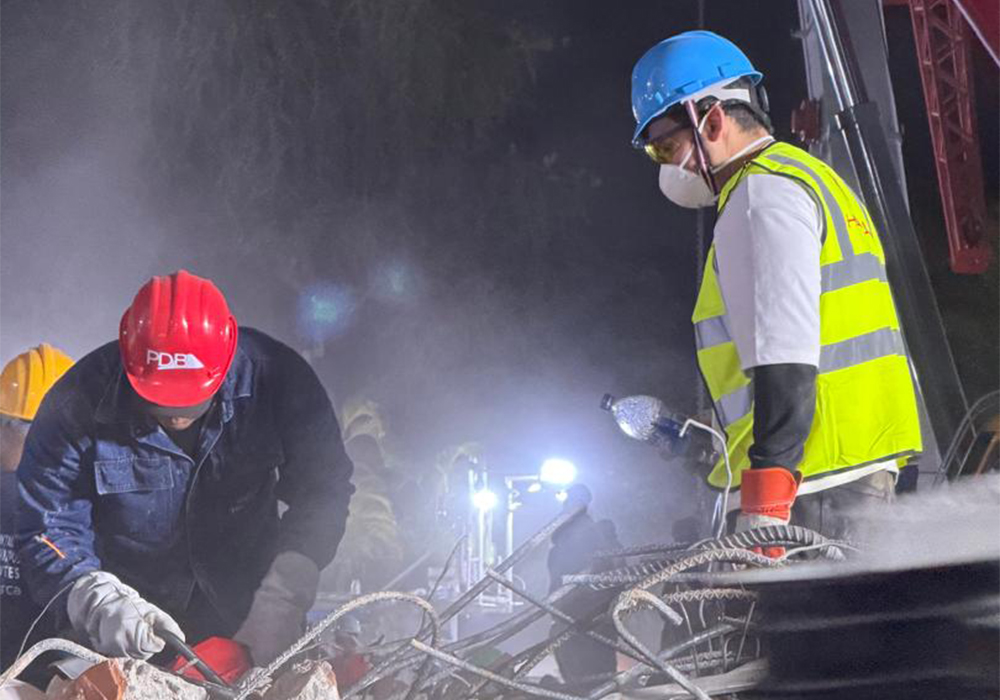
Within a day of the quakes, Agreda was passing out shovels, helmets and gloves to volunteers and aid workers combing through the rubble for survivors. He’s delivered food and medicine to donation centers. He bought a saw able to cut through metal, taught himself how to use it and has been deploying it for several days at a collapsed building in the San Bernardino zone of Caracas.
Mejia, a graduate of the College of Hospitality, Retail and Sport Management, has been helping prepare meals, as well as volunteering at a local hospital.
Agreda said he and the other Venezuelan volunteers have been working at the collapsed building site with a group of aid workers from Qatar, one of dozens of international teams sent to help the under-equipped government in the aftermath.
He also worked with a group of local firefighters to help reach people trapped in the rubble.
“We thought that we heard some voices from within the building,” he said. “So I worked with the firefighters by cutting through an entry point so they could go inside the building, underneath all the rubble.”
Agreda and his family didn’t think twice about jumping in and helping. It’s a common story in Venezuela right now, where volunteers are organizing donation centers, helping at hospitals and combing through mountains of rubble.
In the wake of this tragedy, which came on the heels of major political upheaval, Agreda said the people of Venezuela are coming together to find life in the wreckage.
“The volunteers, we all just want to help each other,” he said. “If you’re at the work site and someone sees that you’re thirsty, they throw you a bottle of water.”
That camaraderie has been vital.
“It’s very hard, but we’re pulling through, we’re trying to stick together,” he said, “just trying to help the people that need the most help.”
Agreda is finding time to be grateful. He’s young, he’s healthy, his friends and family are safe.
“I have it in my hands and I can help, so I think that’s the mentality with all the volunteers that are out there,” he says.
Agreda hopes his USC community will want to help, too.
How you can help
Here are three reputable aid organizations accepting donations to directly help efforts in Venezuela:
- The International Committee of the Red Cross, an independent, nonpartisan global organization dedicated to helping people impacted by violence and armed conflict.
- Samaritan’s Purse, an American nonprofit that recently opened a field hospital in the center of the devastation.
- World Central Kitchen, a global aid organization that mobilizes meal distribution efforts in the wake of disasters by partnering with local restaurants and nonprofits.